<?xml version="1.0" encoding="utf-8"?><feed xmlns="http://www.w3.org/2005/Atom" ><generator uri="https://jekyllrb.com/" version="3.9.5">Jekyll</generator><link href="https://vinuni-indoorcare.github.io/feed.xml" rel="self" type="application/atom+xml" /><link href="https://vinuni-indoorcare.github.io/" rel="alternate" type="text/html" /><updated>2024-07-09T14:34:51+00:00</updated><id>https://vinuni-indoorcare.github.io/feed.xml</id><title type="html">IndoorCare</title><subtitle>Powered by Jekyll &amp; Minimal Mistakes.</subtitle><author><name>IndoorCare</name></author><entry><title type="html">Types of airborne particles and their action mechanisms on human health</title><link href="https://vinuni-indoorcare.github.io/blog/en/2024-07-07-airborne-particels/" rel="alternate" type="text/html" title="Types of airborne particles and their action mechanisms on human health" /><published>2024-07-07T14:59:40+00:00</published><updated>2024-07-07T14:59:40+00:00</updated><id>https://vinuni-indoorcare.github.io/blog/en/airborne-particels</id><content type="html" xml:base="https://vinuni-indoorcare.github.io/blog/en/2024-07-07-airborne-particels/"><![CDATA[<p><em>Author: Nhan Dinh Ngo - VinUniversity</em></p>

<h2 id="types-of-airborne-particles">Types of airborne particles</h2>
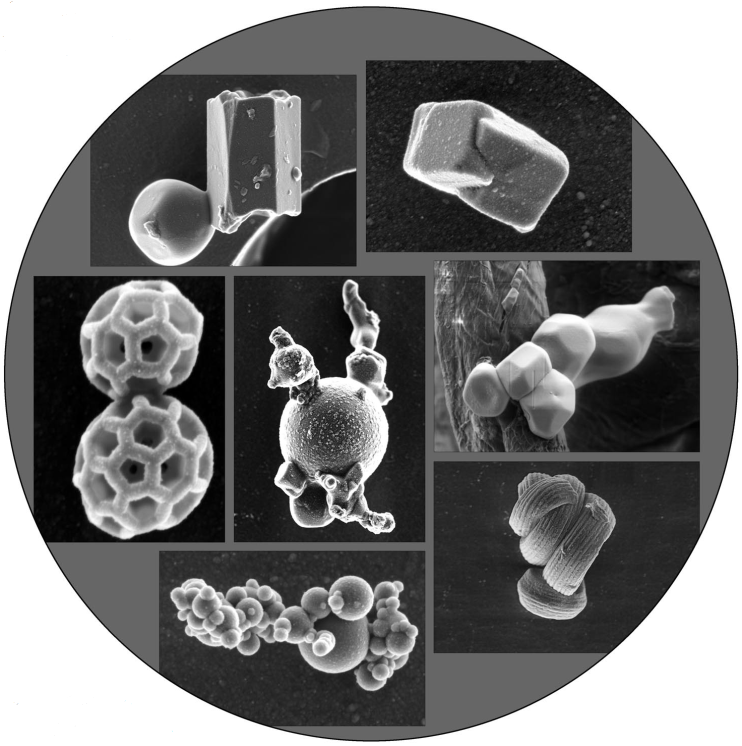
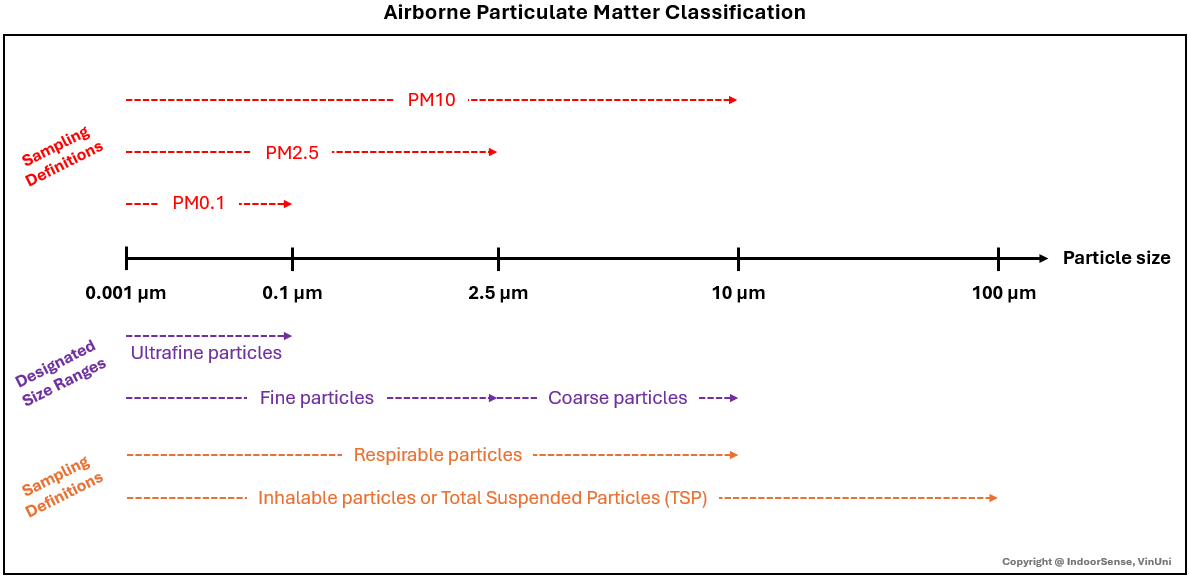
<p>Airborne particles including solids, liquids (droplets), and mixtures of them are present throughout our ambient environment, often denoted by terms like PM<sub>2.5</sub> or fine dust. But what lies behind these designations? Generally, these names denote various airborne particle catalogs classified by size. It is essential to understand that these particles come in diverse sizes and shapes (as <strong>Figure 1</strong>). For instance, liquid particles are nearly always spherical while solid particles usually have complex shapes. Thus, the classification relies not on physical dimensions like diameter, radius, or height, but rather on an equivalent diameter, termed <em>“aerodynamic diameter”</em>. <strong>Figure 2</strong> visualizes the size range of airborne particles. In general:</p>
<ul>
  <li>Total Suspended Particles (TSP), also known as Inhalable Particles, refers to all particles found in the ambient atmosphere. This type of particle is typically 100 micrometers (µm) or less in size. Particles exceeding this threshold fall to the ground quickly by gravitation, thus, they are considered not inhalable.</li>
  <li>In the meanwhile, respirable particles constitute a subset of inhalable particles comprising any smaller particles, typically less than 10 µm in size. While inhalable particles are large enough to be trapped in the nose, throat, and upper respiratory tract, respirable particles are small enough to reach the deepest parts of the lungs bypassing the body’s natural defenses.</li>
  <li>Within the range of respirable particles, various fractions exist, including PM<sub>0.1</sub>, PM<sub>2.5</sub>, and PM<sub>10</sub>. The suffix index denotes the largest particle size. For example, PM<sub>2.5</sub> covers all respirable particles that are 2.5 (µm) or less in size. It’s important to note that PM<sub>10</sub> corresponds to respirable particles, as depicted in <strong>Figure 2</strong>. 
Furthermore, the airborne particles can be categorized into ultrafine, fine, and coarse particles based on Designated Size Ranges as illustrated in <strong>Figure 2</strong>. There is a common misconception that the coarse particles correspond to PM<sub>10</sub>. Unfortunately, it is not actually! Ultrafine and fine particles will correspond to PM<sub>0.1</sub> and PM<sub>2.5</sub>, respectively, while coarse particles constitute only a subset of PM<sub>10</sub>.</li>
</ul>

<p><img src="/assets/images/blog/2024-07-07-airborne-particels_fig1.png" alt="figure 1" class="align-center img-70" /> <em><center><em>Figure 1</em>: Examples of airborne particle’s shapes and sizes (Pöschl, 2005).</center></em>
<img src="/assets/images/blog/2024-07-07-airborne-particels_fig2.png" alt="figure 2" /> <em><center><em>Figure 2</em>: Airborne particle classifications by definitions.</center></em></p>

<p>In conclusion, the airborne particle classification relies on the concept of equivalent diameter, termed <em>“aerodynamic diameter”</em>, rather than physical dimensions. Total Suspended Particles (TSP), or Inhalable Particles by another name, encompass all particles found in the air. Respirable particles, a subset of inhalable particles, comprise various fractions like PM<sub>0.1</sub>, PM<sub>2.5</sub>, and PM<sub>10</sub>. Additionally, airborne particles can be categorized into ultrafine, fine, and coarse particles with ultrafine and fine particles corresponding to PM<sub>0.1</sub> and PM<sub>2.5</sub>, respectively, while coarse particles constitute only a subset of PM<sub>10</sub>.</p>

<h2 id="how-do-airborne-particles-affect-human-health">How do airborne particles affect human health?</h2>
<p>Size and composition both significantly play a role in the mechanisms of action of airborne particles on human health. The size directly relates to the particle’s traveling distance and deposition spots while the composition determines their toxicity. More specifically:</p>
<ul>
  <li>Size of airborne particles: generally, the smaller the particles, the deeper penetration into the human respiratory tract. For instance, only PM2.5 and smaller will penetrate deep into the lungs and some may even get into the bloodstream, while PM10 tends to lodge in the trachea (upper throat) or in the bronchi. Since penetrating the human body, they are carrying various chemical and biological substances, which are present on their surface, into the body therefore causing toxic effects as below explanations.</li>
  <li>Composition of airborne particles: airborne particles can act as carriers of compound particles with chemical and biological origins (Guo et al., 2018). For example, transition metals present in particles, especially iron, increase the production of reactive oxygen species (ROS). As the release of ROS can result in cellular and tissue damage, it can thus initiate or exacerbate inflammation. Another example of the health effects of biological source-laden airborne particles is that the endotoxins, a kind of toxic release from bacteria, can adhere to the surface of particles and accompany them into the lungs, thereby resulting in more pronounced immunological reactions than the particles themselves.</li>
</ul>

<p>In summary, the main mechanism of action of airborne particles on human health, specifically on the respiratory system, lies in the chemical and biological composition carried by particles, thereby inducing adverse effects such as oxidative stress and inflammation.</p>

<h2 id="references">References</h2>
<p>Guo, Z., Wang, Z., Qian, L., Zhao, Z., Zhang, C., Fu, Y., Li, J., Zhang, C., Lu, B., &amp; Qian, J. (2018). Biological and chemical compositions of atmospheric particulate matter during hazardous haze days in Beijing. Environmental Science and Pollution Research International, 25(34), 34540.
Pöschl, U. (2005). Atmospheric aerosols: composition, transformation, climate and health effects. Angewandte Chemie (International Ed. in English), 44(46), 7520–7540.</p>]]></content><author><name>IndoorCare</name></author><category term="blog" /><category term="particulate matter" /><category term="air quality" /><category term="human health" /><category term="airborne particle definitions" /><summary type="html"><![CDATA[Author: Nhan Dinh Ngo - VinUniversity]]></summary></entry><entry><title type="html">Các loại hạt trong không khí và cơ chế ảnh hưởng của chúng lên sức khỏe con người</title><link href="https://vinuni-indoorcare.github.io/blog/vi/2024-07-07-airborne-particels/" rel="alternate" type="text/html" title="Các loại hạt trong không khí và cơ chế ảnh hưởng của chúng lên sức khỏe con người" /><published>2024-07-07T14:59:40+00:00</published><updated>2024-07-07T14:59:40+00:00</updated><id>https://vinuni-indoorcare.github.io/blog/vi/airborne-particels</id><content type="html" xml:base="https://vinuni-indoorcare.github.io/blog/vi/2024-07-07-airborne-particels/"><![CDATA[<p><em>Tác giả: Ngô Đình Nhân - VinUniversity</em></p>

<h2 id="các-loại-hạt-lơ-lửng-trong-không-khí">Các loại hạt lơ lửng trong không khí</h2>
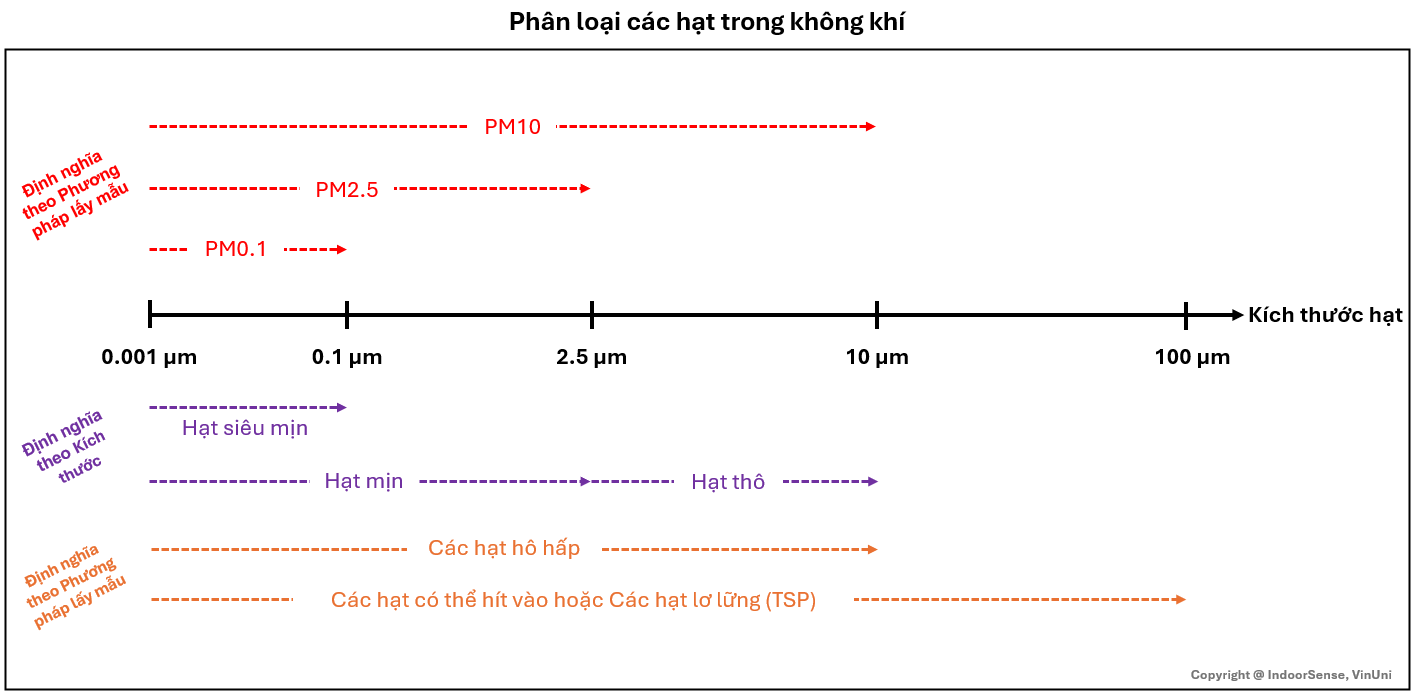
<p>Các hạt tồn tại trong không khí có thể là các hạt rắn, các giọt lỏng, hoặc là dạng hổn hợp của hai trạng thái trên. Các hạt này thường được gọi với một thuật ngữ nhất định như PM<sub>2.5</sub> hoặc bụi mịn. Vậy, ý nghĩa thực sự của các tên gọi này là gì? Thông thường, những tên gọi này biểu thị các loại hạt trong không khí được phân loại theo kích thước (<strong>Hình 1</strong>). Tuy nhiên, trong thực thế, các hạt thường đa dạng về kích thước củng như hình dạng. Ví dụ như, các giọt lỏng gần như luôn có dạng hình cầu, trong khi các hạt rắn thì có hình dạng phức tạp hơn. Do vậy, việc phân loại các hạt không dựa trên các thông số vật lý như đường kính, bán kính, hoặc chiều cao, mà dựa vào một giá trị đường kính quy đổi, gọi là <em>“đường kính khí động học”</em>. <strong>Hình 2</strong> mô tả kích thước cụ thể của từng loại hạt. Cụ thể là:</p>
<ul>
  <li>Các hạt lơ lững (TSP), còn gọi là các hạt có thể hít, bao gồm tất cả các hạt trong không khí có kích thước bằng khoảng 100 micro mét hoặc nhỏ hơn. Những hạt lớn hơn ngưỡng này thì thường tồn tại trong một khoảng thời gian rất ngắn trong khí và rơi xuống đất nhanh chóng do tác dụng của trọng lực.</li>
  <li>Trong khi đó, các hạt hô hấp là một nhóm các hạt hít vào có kích thước dưới 10 micro mét. Trong khi các hạt hít vào có kích thước đủ lớn để bị giữ lại trong mũi, cổ họng và đường hô hấp trên, các hạt hô hấp có kích thước đủ nhỏ để xâm nhập vào các phần sâu nhất của phổi, vượt qua các cơ chế phòng vệ tự nhiên của cơ thể.</li>
  <li>Các hạt hô hấp có thể phân loại thành nhiều nhóm nhỏ khác nhau, bao gồm PM<sub>0.1</sub>, PM<sub>2.5</sub> và PM<sub>10</sub>. Chỉ số đi kèm biểu thị kích thước hạt lớn nhất trong nhóm đó. Ví dụ, PM<sub>2.5</sub> bao gồm tất cả các hạt hô hấp có kích thước 2.5 µm hoặc nhỏ hơn. Điều quan trọng cần lưu ý đó là PM<sub>10</sub> tương ứng với các hạt hô hấp, như được minh họa trong <strong>Hình 2</strong>.
Ngoài ra, các hạt trong không khí có thể được phân loại thành hạt siêu mịn, mịn và thô dựa trên các dãi kích thước như minh họa trong <strong>Hình 2</strong>. Có một quan niệm sai lầm phổ biến rằng các hạt thô tương ứng với PM<sub>10</sub>. Thực tế thì không phải như vậy! Các hạt siêu mịn và mịn sẽ tương ứng với PM<sub>0.1</sub> và PM<sub>2.5</sub>, trong khi các hạt thô chỉ là một thành phần của PM<sub>10</sub>.</li>
</ul>

<p><img src="/assets/images/blog/2024-07-07-airborne-particels_fig1.png" alt="figure 1" class="align-center img-70" /> <em><center><b>Hình 1</b>: Các ví dụ về kích thước và hình dạng của các hạt trong không khí (Pöschl, 2005). </center></em>
<img src="/assets/images/blog/2024-07-07-airborne-particels_fig2_vi.png" alt="figure 2" /> <em><center><b>Hình 2</b>: Định nghĩa các loại hạt trong không khí.</center></em></p>

<p>Kết luận lại, việc phân loại các hạt trong không khí dựa trên khái niệm đường kính tương đương, gọi là <em>“đường kính khí động học”</em>, thay vì các kích thước vật lý. Các hạt lơ lửng (TSP), hay còn gọi là hạt có thể hít vào (hạt hít vào), bao gồm tất cả các hạt có trong không khí. Các hạt hô hấp, là một phần của các hạt hít vào, bao gồm nhiều nhóm nhỏ như PM<sub>0.1</sub>, PM<sub>2.5</sub> và PM<sub>10</sub>. Ngoài ra, các hạt trong không khí có thể được phân loại thành hạt siêu mịn, mịn và thô, trong đó các hạt siêu mịn và mịn tương ứng với PM<sub>0.1</sub> và PM<sub>2.5</sub>, trong khi các hạt thô chỉ là một thành phần của PM<sub>10</sub>.</p>

<h2 id="cơ-chế-tác-động-của-các-hạt-trong-không-khí-lên-sức-khoẻ-con-người">Cơ chế tác động của các hạt trong không khí lên sức khoẻ con người</h2>
<p>Kích thước và thành phần đều đóng vai trò quan trọng trong các cơ chế tác động của các hạt trong không khí lên sức khỏe con người. Kích thước liên quan trực tiếp đến khoảng cách di chuyển và vị trí lắng đọng của các hạt, trong khi thành phần quyết định độc tính của chúng. Cụ thể:</p>
<ul>
  <li>Kích thước của các hạt trong không khí: nhìn chung, hạt càng nhỏ thì càng xâm nhập sâu vào đường hô hấp của con người. Chẳng hạn, chỉ có PM<sub>2.5</sub> và các hạt nhỏ hơn mới xâm nhập sâu vào phổi và một số thậm chí có thể xâm nhập vào máu, trong khi PM<sub>10</sub> có xu hướng mắc lại ở khí quản (họng trên) hoặc ở phế quản. Khi xâm nhập vào cơ thể con người, chúng mang theo các chất hóa học và sinh học có mặt trên bề mặt của chúng vào cơ thể, do đó gây ra các tác động độc hại lên hệ hô hấp cung như các cơ quan trong cơ thể.</li>
  <li>Thành phần của các hạt trong không khí: các hạt trong không khí có thể hoạt động như những phương tiện vận chuyển các hợp chất có nguồn gốc hóa học và sinh học (Guo et al., 2018). Ví dụ, các kim loại có mặt trong các hạt, đặc biệt là sắt, làm tăng sản xuất các loại oxy hoạt động (Reactive Oxygen Species: ROS). Vì việc giải phóng ROS có thể dẫn đến tổn thương tế bào và mô, từ đó có thể gây ra hoặc làm trầm trọng thêm tình trạng viêm nhiễm. Một ví dụ khác về các tác động sức khỏe của các hạt trong không khí chứa nguồn gốc sinh học là nội độc tố, một loại độc tố được tiết ra từ vi khuẩn, có thể bám vào bề mặt của các hạt và cùng chúng xâm nhập vào phổi, do đó dẫn đến các phản ứng miễn dịch rõ rệt hơn so với các hạt thông thường.</li>
</ul>

<p>Tóm lại, cơ chế tác động chính của các hạt trong không khí lên sức khỏe con người, cụ thể là trên hệ hô hấp, nằm ở thành phần hóa học và sinh học mà các hạt mang theo, do đó gây ra các tác động bất lợi làm tổn thương tế bào và mô.</p>

<h2 id="tài-liệu-tham-khảo">Tài liệu tham khảo</h2>
<p>Guo, Z., Wang, Z., Qian, L., Zhao, Z., Zhang, C., Fu, Y., Li, J., Zhang, C., Lu, B., &amp; Qian, J. (2018). Biological and chemical compositions of atmospheric particulate matter during hazardous haze days in Beijing. Environmental Science and Pollution Research International, 25(34), 34540.
Pöschl, U. (2005). Atmospheric aerosols: composition, transformation, climate and health effects. Angewandte Chemie (International Ed. in English), 44(46), 7520–7540.</p>]]></content><author><name>IndoorCare</name></author><category term="blog" /><category term="hạt lơ lửng" /><category term="chất lượng không khí" /><category term="sức khỏe con người" /><category term="hạt lơ lửng trong không khí" /><summary type="html"><![CDATA[Tác giả: Ngô Đình Nhân - VinUniversity]]></summary></entry><entry><title type="html">Indoor PM2.5 concentrations in residential houses and influencing factors in Hanoi, Vietnam</title><link href="https://vinuni-indoorcare.github.io/blog/en/2024-05-16-indoor-pm2.5/" rel="alternate" type="text/html" title="Indoor PM2.5 concentrations in residential houses and influencing factors in Hanoi, Vietnam" /><published>2024-05-16T04:54:40+00:00</published><updated>2024-05-16T04:54:40+00:00</updated><id>https://vinuni-indoorcare.github.io/blog/en/indoor-pm2.5</id><content type="html" xml:base="https://vinuni-indoorcare.github.io/blog/en/2024-05-16-indoor-pm2.5/"><![CDATA[<p><em>Author: Dat Mac Van - Hanoi University of Civil Engineering</em></p>

<h2 id="what-is-pm25">What is PM<sub>2.5</sub>?</h2>
<p>PM<sub>2.5</sub> refers to fine particulate matter with a diameter of 2.5 micrometers or smaller. PM<sub>2.5</sub> can penetrate deep into the lungs, irritate and corrode the alveolar wall, and consequently impair lung functions and even cause lung cancer [1], [2], [3]. People spend about 90% of their time in indoor environments (in houses, offices, schools, etc.), and therefore, indoor PM<sub>2.5</sub> may directly affect human health. In this post, we will explore indoor PM<sub>2.5</sub> concentrations in houses and the factors that influence indoor PM<sub>2.5</sub> levels in Hanoi, Vietnam.</p>

<h2 id="indoor-pm25-concentration-in-houses-in-hanoi-vietnam">Indoor PM<sub>2.5</sub> concentration in houses in Hanoi, Vietnam</h2>
<p>In Vietnam, air pollution has become increasingly severe in recent decades, particularly in major cities like Hanoi, where there has been a rise in concentrations of fine particle matter such as PM<sub>1.0</sub>, PM<sub>2.5</sub>, and PM<sub>10</sub> [4], [5]. In Hanoi, a study showed that mortality attributable to long-term exposure to PM2.5 was 34.3 per 100,000 population was higher than that in Bangkok with 21 per 100,000 population [6].</p>

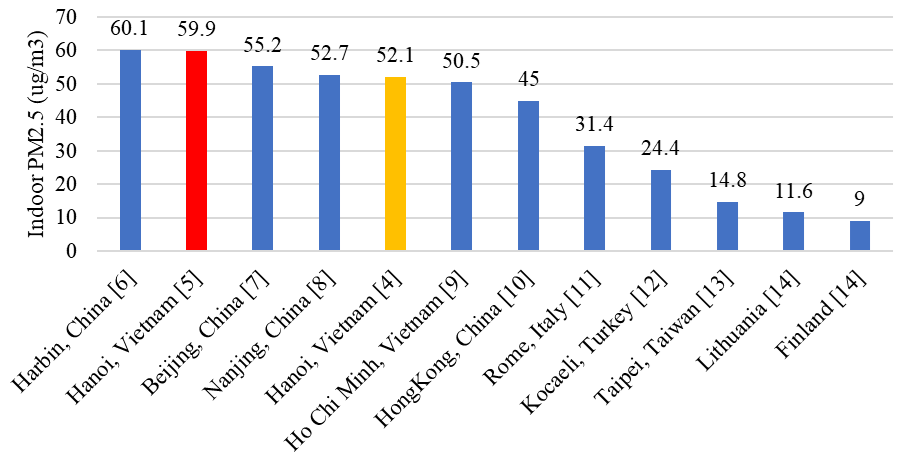
<p>In a study with 32 urban residential homes, L. K. Tran et al. [7] reported that the average indoor PM<sub>2.5</sub> levels in Hanoi (52.1 μg/m<sup>3</sup>) were about 3–5 times higher than those measured in the Western countries’ homes and Taipei. But the figure was similar to other cities in Asia such as Nanjing (China), Sari (Iran), and Ho Chi Minh (Vietnam) (Figure 1). In most monitored homes, the indoor PM<sub>2.5</sub> concentrations exceeded the WHO guideline (15 μg/m<sup>3</sup>). Over 47 % of the homes had a daily average indoor PM2.5 concentration greater than 50 μg/m<sup>3</sup>, the recommended guideline in Vietnam. In another study, Vo et al. found that the average concentration of indoor PM<sub>2.5</sub> measured in the three dwellings was 59.9 μg/m<sup>3</sup> which is approximately four times higher than the WHO guideline [8]. Thus, we can see that indoor PM<sub>2.5</sub> concentrations in households in Hanoi were at high levels. What are the causes that affect PM<sub>2.5</sub>?</p>

<p><img src="/assets/images/blog/2024-05-16-indoor-pm2.5_fig1.png" alt="figure_1" /> <em><center><b>Figure 1</b>: Mean Indoor PM2.5 in Hanoi compared to other cities.</center></em></p>

<h2 id="factors-that-can-affect-levels-of-indoor-pm25">Factors that can affect levels of indoor PM<sub>2.5</sub></h2>
<ul>
  <li><strong>Outdoor PM<sub>2.5</sub> concentrations</strong>: Outdoor PM<sub>2.5</sub> pollution sources, such as traffic emissions, industrial activities, wildfires, and straw burning, can infiltrate indoor environments through ventilation systems, windows, and doors.</li>
  <li><strong>Indoor sources</strong>: Indoor activities like cooking, smoking, burning candles or incense can release PM<sub>2.5</sub> particles directly into the indoor air.</li>
  <li><strong>Occupant activities</strong>: Human activities and behaviors within indoor spaces, such as cooking frequency, use of heating appliances, and smoking habits, can contribute to indoor PM<sub>2.5</sub> concentrations.</li>
  <li><strong>Ventilation and air exchanger</strong>: the rate of ventilation and air exchange within a building can significantly influence indoor PM<sub>2.5</sub> concentrations. Poor ventilation can lead to the accumulation of pollutants indoors, while proper ventilation can help dilute indoor pollutants.</li>
  <li><strong>Filtration and air cleaning devices</strong>: The presence and efficiency of air filtration systems and air purifiers can affect indoor PM<sub>2.5</sub> levels by capturing and removing particles from the air.</li>
  <li><strong>Other</strong>: Factors such as building age, construction materials, insulation, and airtightness can impact indoor PM<sub>2.5</sub> levels. Older buildings or those with poor insulation may be more susceptible to infiltration of outdoor pollutants.</li>
</ul>

<h2 id="intervention-to-reduce-pm25-in-the-houses">Intervention to reduce PM2.5 in the houses:</h2>
<ul>
  <li><strong>Open Windows</strong>: When outdoor air quality is good, open windows to allow fresh air to circulate. This helps dilute indoor pollutants.</li>
  <li><strong>Avoid Smoking Indoors</strong>: Smoking is a major source of PM2.5 indoors. Ensure smoking is done outside, away from doors and windows.</li>
  <li><strong>HVAC System Filters</strong>: Upgrade to high-quality filters in your heating, ventilation, and air conditioning (HVAC) system.</li>
  <li><strong>Air purifiers</strong>: Use air purifiers equipped with HEPA (High-Efficiency Particulate Air) filters to capture fine particles. Place them in commonly used areas such as living rooms and bedrooms.</li>
</ul>

<p>Each factor will have different effects on indoor PM<sub>2.5</sub> concentrations. To quantify the influence of sources on indoor PM<sub>2.5</sub>concentrations, we need to conduct further studies.</p>

<p><strong><em>Continue…</em></strong></p>

<h2 id="references">References</h2>
<p>[1]	F. Huang, B. Pan, J. Wu, E. Chen, and L. Chen, “Relationship between exposure to PM2. 5 and lung cancer incidence and mortality: A meta-analysis,” Oncotarget, vol. 8, no. 26, p. 43322, 2017.</p>

<p>[2]	B. Yang, J. Guo, and C. Xiao, “Effect of PM2. 5 environmental pollution on rat lung,” Environmental Science and Pollution Research, vol. 25, pp. 36136–36146, 2018.</p>

<p>[3]	Y.-F. Xing, Y.-H. Xu, M.-H. Shi, and Y.-X. Lian, “The impact of PM2. 5 on the human respiratory system,” J Thorac Dis, vol. 8, no. 1, p. E69, 2016.</p>

<p>[4]	N. T. K. Oanh et al., “Particulate air pollution in six Asian cities: Spatial and temporal distributions, and associated sources,” Atmos Environ, vol. 40, no. 18, pp. 3367–3380, 2006.</p>

<p>[5]	N. T. T. Thuy, N. T. Dung, K. Sekiguchi, L. B. Thuy, N. T. T. Hien, and R. Yamaguchi, “Mass concentrations and carbonaceous compositions of PM0. 1, PM2. 5, and PM10 at urban locations of Hanoi, Vietnam,” Aerosol Air Qual Res, vol. 18, no. 7, pp. 1591–1605, 2018.</p>

<p>[6]	N. T. T. Nhung et al., “Mortality burden due to exposure to outdoor fine particulate matter in Hanoi, Vietnam: health impact assessment,” Int J Public Health, vol. 67, p. 1604331, 2022.</p>

<p>[7]	L. K. Tran et al., “The impact of incense burning on indoor PM2. 5 concentrations in residential houses in Hanoi, Vietnam,” Build Environ, vol. 205, p. 108228, 2021.</p>

<p>[8]	L.-H. T. Vo et al., “Indoor PM0. 1 and PM2. 5 in Hanoi: chemical characterization, source identification, and health risk assessment,” Atmos Pollut Res, vol. 13, no. 2, p. 101324, 2022.</p>]]></content><author><name>IndoorCare</name></author><category term="blog" /><category term="indoor PM&lt;sub&gt;2.5&lt;/sub&gt;" /><category term="residential house" /><summary type="html"><![CDATA[Author: Dat Mac Van - Hanoi University of Civil Engineering]]></summary></entry><entry><title type="html">Nồng độ bụi PM2.5 trong nhà ở và các yếu tố ảnh hưởng tại Hà Nội, Việt Nam</title><link href="https://vinuni-indoorcare.github.io/blog/vi/2024-05-16-indoor-pm2.5/" rel="alternate" type="text/html" title="Nồng độ bụi PM2.5 trong nhà ở và các yếu tố ảnh hưởng tại Hà Nội, Việt Nam" /><published>2024-05-16T04:54:40+00:00</published><updated>2024-05-16T04:54:40+00:00</updated><id>https://vinuni-indoorcare.github.io/blog/vi/indoor-pm2.5</id><content type="html" xml:base="https://vinuni-indoorcare.github.io/blog/vi/2024-05-16-indoor-pm2.5/"><![CDATA[<p><em>Tác giả: Mạc Văn Đạt - Trường Đại học Xây dựng Hà Nội</em></p>

<h2 id="pm25-là-gì">PM<sub>2.5</sub> là gì?</h2>
<p>PM<sub>2.5</sub> được biết đến là bụi mịn có đường kính 2.5 μm hoặc nhỏ hơn. Bụi PM<sub>2.5</sub> có thể xâm nhập sâu vào phổi, gây kích ứng và ăn mòn thành phế nang, từ đó làm suy giảm chức năng của phổi, thậm chí gây ung thư phổi [1], [2], [3]. Mọi người dành khoảng 90% thời gian ở môi trường trong nhà (trong nhà, văn phòng, trường học, v.v.) và do đó, PM<sub>2.5</sub> trong nhà có thể ảnh hưởng trực tiếp đến sức khỏe con người. Trong bài viết này, chúng ta sẽ tìm hiểu nồng độ PM<sub>2.5</sub> trong nhà trong nhà, các yếu tố ảnh hưởng và biện pháp giảm thiểu nồng độ PM<sub>2.5</sub> trong nhà ở tại Hà Nội, Việt Nam.</p>

<h2 id="nồng-độ-bụi-pm25-trong-nhà-ở-tại-hà-nội-việt-nam">Nồng độ bụi PM<sub>2.5</sub> trong nhà ở tại Hà Nội, Việt Nam</h2>
<p>Tại Việt Nam, ô nhiễm không khí ngày càng trở nên nghiêm trọng trong những thập kỷ gần đây, đặc biệt là ở các thành phố lớn như Hà Nội, nơi có những thời điểm ghi nhận nồng độ bụi mịn ở mức rất cao. Năm 2021, một nghiên cứu được tiến hành tại 32 nhà ở ghi nhận nồng độ bụi PM<sub>2.5</sub> trung bình trong nhà đạt 52.1 μg/m<sup>3</sup> [4]. Sau đó năm 2022, một nghiên cứu khác với kết quả cao hơn trước đó được công bố với giá trị nồng độ bụi PM<sub>2.5</sub> trung bình trong nhà đạt 59.9 μg/m<sup>3</sup> [5]. Các kết quả này cao hơn gần 4 lần so với khuyến nghị nồng độ bụi PM<sub>2.5</sub> trong nhà do WHO đưa ra (15 μg/m<sup>3</sup>).  Hình 1 so sánh nồng độ bụi PM<sub>2.5</sub>  trung bình tại Hà Nội với Hồ Chí Minh và các thành phố khác trong khu vực và trên thế giới [6-14]. Qua đó, giá trị nồng độ bụi PM<sub>2.5</sub> trung bình trong nhà Hà Nội tương tự như Hồ Chí Minh và một số thành phố của Trung Quốc, nhưng cao hơn 2- 6 lần so với các thành phố tại Phương Tây. Vậy đâu là nguyên nhân ảnh hưởng đến nồng độ bụi PM<sub>2.5</sub> trung bình trong nhà?</p>

<p><img src="/assets/images/blog/2024-05-16-indoor-PM2.5_fig1_vi.png" alt="figure_1" /> <em><center><b>Hình 1</b>: Nồng độ trung bình bụi PM<sub>2.5</sub> trong nhà tại Hà Nội so với các thành phố khác.</center></em></p>

<h2 id="các-yếu-tố-ảnh-hướng-đến-nồng-độ-bụi-pm25-trong-nhà">Các yếu tố ảnh hướng đến nồng độ bụi PM<sub>2.5</sub> trong nhà</h2>
<ul>
  <li><strong>Nồng độ PM<sub>2.5</sub> ngoài trời</strong>: Các nguồn ô nhiễm PM<sub>2.5</sub> ngoài trời, chẳng hạn như khí thải giao thông, hoạt động công nghiệp, cháy rừng và đốt rơm, có thể xâm nhập vào môi trường trong nhà thông qua hệ thống thông gió, cửa sổ và cửa ra vào.</li>
  <li><strong>Nguồn trong nhà</strong>: Các hoạt động trong nhà như nấu ăn, hút thuốc, đốt nến hoặc thắp hương có thể thải ra các hạt PM<sub>2.5</sub> trực tiếp vào không khí trong nhà.</li>
  <li><strong>Hoạt động của người sử dụng</strong>: Các hoạt động và hành vi của con người trong không gian trong nhà, chẳng hạn như nấu ăn, sử dụng thiết bị sưởi và thói quen hút thuốc, có thể góp phần làm tăng nồng độ PM<sub>2.5</sub> trong nhà.</li>
  <li><strong>Thông gió và trao đổi không khí</strong>: tốc độ thông gió và trao đổi không khí trong tòa nhà có thể ảnh hưởng đáng kể đến nồng độ PM<sub>2.5</sub> trong nhà. Thông gió kém có thể dẫn đến sự tích tụ các chất ô nhiễm trong nhà, trong khi thông gió thích hợp có thể giúp làm giảm các chất ô nhiễm trong nhà.</li>
  <li><strong>Thiết bị lọc và làm sạch không khí</strong>: Sự hiện diện và hiệu quả của hệ thống lọc không khí và máy lọc không khí có thể ảnh hưởng đến mức PM<sub>2.5</sub> trong nhà bằng cách thu giữ và loại bỏ các hạt trong không khí.</li>
  <li><strong>Các yếu tố khác</strong>: Các yếu tố như tuổi của tòa nhà, vật liệu xây dựng, khả năng cách nhiệt và độ kín khí có thể ảnh hưởng đến mức PM<sub>2.5</sub> trong nhà. Các tòa nhà cũ hoặc những tòa nhà có khả năng cách nhiệt kém có thể dễ bị các chất ô nhiễm ngoài trời xâm nhập hơn.</li>
</ul>

<h2 id="một-số-biện-pháp-cải-thiện-giảm-nồng-độ-pm25-trong-nhà">Một số biện pháp cải thiện giảm nồng độ PM<sub>2.5</sub> trong nhà</h2>
<ul>
  <li><strong>Mở cửa sổ</strong>: Khi chất lượng không khí ngoài trời tốt, hãy mở cửa sổ để không khí trong lành lưu thông. Điều này giúp làm loãng các chất ô nhiễm trong nhà.</li>
  <li><strong>Tránh hút thuốc trong nhà</strong>: Hút thuốc là nguồn chính tạo ra PM<sub>2.5</sub> trong nhà. Đảm bảo hút thuốc được thực hiện bên ngoài, tránh xa cửa ra vào và cửa sổ.</li>
  <li><strong>Hệ thống HVAC</strong>: Nâng cấp lên bộ lọc chất lượng cao trong hệ thống sưởi, thông gió và điều hòa không khí.</li>
  <li><strong>Máy lọc không khí</strong>: Sử dụng máy lọc không khí được trang bị bộ lọc HEPA để thu giữ các hạt mịn. Đặt chúng ở những khu vực thường được sử dụng như phòng khách và phòng ngủ.</li>
</ul>

<p>Mỗi yếu tố sẽ có tác động khác nhau tới nồng độ PM<sub>2.5</sub> trong nhà. Để định lượng mức độ ảnh hưởng của các nguồn đến nồng độ PM<sub>2.5</sub> trong nhà, chúng ta cần tiến hành các nghiên cứu sâu hơn.</p>

<p><strong><em>Còn tiếp…</em></strong></p>

<h2 id="tài-liệu-tham-khảo">Tài liệu tham khảo</h2>
<p>[1]	F. Huang, B. Pan, J. Wu, E. Chen, and L. Chen, “Relationship between exposure to PM2. 5 and lung cancer incidence and mortality: A meta-analysis,” Oncotarget, vol. 8, no. 26, p. 43322, 2017.</p>

<p>[2]	B. Yang, J. Guo, and C. Xiao, “Effect of PM2. 5 environmental pollution on rat lung,” Environmental Science and Pollution Research, vol. 25, pp. 36136–36146, 2018.</p>

<p>[3]	Y.-F. Xing, Y.-H. Xu, M.-H. Shi, and Y.-X. Lian, “The impact of PM2. 5 on the human respiratory system,” J Thorac Dis, vol. 8, no. 1, p. E69, 2016.</p>

<p>[4]	N. T. K. Oanh et al., “Particulate air pollution in six Asian cities: Spatial and temporal distributions, and associated sources,” Atmos Environ, vol. 40, no. 18, pp. 3367–3380, 2006.</p>

<p>[5]	N. T. T. Thuy, N. T. Dung, K. Sekiguchi, L. B. Thuy, N. T. T. Hien, and R. Yamaguchi, “Mass concentrations and carbonaceous compositions of PM0. 1, PM2. 5, and PM10 at urban locations of Hanoi, Vietnam,” Aerosol Air Qual Res, vol. 18, no. 7, pp. 1591–1605, 2018.</p>

<p>[6]	N. T. T. Nhung et al., “Mortality burden due to exposure to outdoor fine particulate matter in Hanoi, Vietnam: health impact assessment,” Int J Public Health, vol. 67, p. 1604331, 2022.</p>

<p>[7]	L. K. Tran et al., “The impact of incense burning on indoor PM2. 5 concentrations in residential houses in Hanoi, Vietnam,” Build Environ, vol. 205, p. 108228, 2021.</p>

<p>[8]	L.-H. T. Vo et al., “Indoor PM0. 1 and PM2. 5 in Hanoi: chemical characterization, source identification, and health risk assessment,” Atmos Pollut Res, vol. 13, no. 2, p. 101324, 2022.</p>]]></content><author><name>IndoorCare</name></author><category term="blog" /><category term="bụi PM&lt;sub&gt;2.5&lt;/sub&gt; trong nhà" /><category term="nhà ở" /><summary type="html"><![CDATA[Tác giả: Mạc Văn Đạt - Trường Đại học Xây dựng Hà Nội]]></summary></entry><entry><title type="html">[Working paper] Comparison of energy consumption and thermal comfort between rooms with inverter and non-inverter air conditioning in Hanoi, Vietnam</title><link href="https://vinuni-indoorcare.github.io/publications/en/2024-04-25-datmv2024a/" rel="alternate" type="text/html" title="[Working paper] Comparison of energy consumption and thermal comfort between rooms with inverter and non-inverter air conditioning in Hanoi, Vietnam" /><published>2024-04-25T04:54:40+00:00</published><updated>2024-04-25T04:54:40+00:00</updated><id>https://vinuni-indoorcare.github.io/publications/en/datmv2024a</id><content type="html" xml:base="https://vinuni-indoorcare.github.io/publications/en/2024-04-25-datmv2024a/"><![CDATA[<p>Author: Mac Van Dat, Bui Khanh Nam, Dung D. Le, Nguyen V. Hoa, Tran Ngoc Quang</p>

<p>We are working on it</p>]]></content><author><name>IndoorCare</name></author><category term="publications" /><category term="research" /><category term="publication" /><category term="working_paper" /><summary type="html"><![CDATA[Author: Mac Van Dat, Bui Khanh Nam, Dung D. Le, Nguyen V. Hoa, Tran Ngoc Quang]]></summary></entry><entry><title type="html">[Working paper] Influence of Air Conditioning (AC) and Air Purifiers (AP) on Indoor PM2.5 in Urban Residential Houses in Hanoi, Vietnam</title><link href="https://vinuni-indoorcare.github.io/publications/en/2024-04-25-datmv2024b/" rel="alternate" type="text/html" title="[Working paper] Influence of Air Conditioning (AC) and Air Purifiers (AP) on Indoor PM2.5 in Urban Residential Houses in Hanoi, Vietnam" /><published>2024-04-25T04:54:40+00:00</published><updated>2024-04-25T04:54:40+00:00</updated><id>https://vinuni-indoorcare.github.io/publications/en/datmv2024b</id><content type="html" xml:base="https://vinuni-indoorcare.github.io/publications/en/2024-04-25-datmv2024b/"><![CDATA[<p>Author: Mac Van Dat, Bui Khanh Nam, Dung D. Le, V.Vishal, J. Jinhui, Nguyen V. Hoa, Tran Ngoc Quang</p>

<p>We are working on it</p>]]></content><author><name>IndoorCare</name></author><category term="publications" /><category term="research" /><category term="publication" /><category term="working_paper" /><summary type="html"><![CDATA[Author: Mac Van Dat, Bui Khanh Nam, Dung D. Le, V.Vishal, J. Jinhui, Nguyen V. Hoa, Tran Ngoc Quang]]></summary></entry><entry><title type="html">[Working paper] Comparison of energy consumption and thermal comfort between rooms with inverter and non-inverter air conditioning in Hanoi, Vietnam</title><link href="https://vinuni-indoorcare.github.io/publications/vi/2024-04-25-datmv2024a/" rel="alternate" type="text/html" title="[Working paper] Comparison of energy consumption and thermal comfort between rooms with inverter and non-inverter air conditioning in Hanoi, Vietnam" /><published>2024-04-25T04:54:40+00:00</published><updated>2024-04-25T04:54:40+00:00</updated><id>https://vinuni-indoorcare.github.io/publications/vi/datmv2024a</id><content type="html" xml:base="https://vinuni-indoorcare.github.io/publications/vi/2024-04-25-datmv2024a/"><![CDATA[<p>Tác giả: Mạc Văn Đạt, Bùi Khánh Nam, Lê Duy Dũng, Nguyễn Việt Hoà, Trần Ngọc Quang</p>

<p>Đang cập nhật</p>]]></content><author><name>IndoorCare</name></author><category term="publications" /><category term="research" /><category term="publication" /><category term="working_paper" /><summary type="html"><![CDATA[Tác giả: Mạc Văn Đạt, Bùi Khánh Nam, Lê Duy Dũng, Nguyễn Việt Hoà, Trần Ngọc Quang]]></summary></entry><entry><title type="html">[Working paper] Influence of Air Conditioning (AC) and Air Purifiers (AP) on Indoor PM2.5 in Urban Residential Houses in Hanoi, Vietnam</title><link href="https://vinuni-indoorcare.github.io/publications/vi/2024-04-25-datmv2024b/" rel="alternate" type="text/html" title="[Working paper] Influence of Air Conditioning (AC) and Air Purifiers (AP) on Indoor PM2.5 in Urban Residential Houses in Hanoi, Vietnam" /><published>2024-04-25T04:54:40+00:00</published><updated>2024-04-25T04:54:40+00:00</updated><id>https://vinuni-indoorcare.github.io/publications/vi/datmv2024b</id><content type="html" xml:base="https://vinuni-indoorcare.github.io/publications/vi/2024-04-25-datmv2024b/"><![CDATA[<p>Tác giả: Mạc Văn Đạt, Bùi Khánh Nam, Lê Duy Dũng, V.Vishal, J. Jinhui, Nguyễn Việt Hoà, Trần Ngọc Quang</p>

<p>Đang cập nhật</p>]]></content><author><name>IndoorCare</name></author><category term="publications" /><category term="research" /><category term="publication" /><category term="working_paper" /><summary type="html"><![CDATA[Tác giả: Mạc Văn Đạt, Bùi Khánh Nam, Lê Duy Dũng, V.Vishal, J. Jinhui, Nguyễn Việt Hoà, Trần Ngọc Quang]]></summary></entry></feed>